Written by
AI, Productivity…and a Rare Opportunity Agreement in IR
The headline from a recent edition of The Australian Financial Review is hard to ignore:
“Employees must share in the gains from AI… or we risk a permanent hit to quality of life”.
That’s Amanda Rishworth speaking at the AFR Workforce Summit. She’s right. But if we’re honest, there’s an uncomfortable tension sitting just beneath it.
The Bit No One Is Saying Out Loud
For the past decade:
- Productivity growth has drifted along at <1%
- Wages have grown ~2.5–3%
- And of course no one has been volunteering to accept wage decreases by linking pay to falling productivity.
So we’ve lived in a world where:
- Employees feel poorer (inflation)
- Employers feel squeezed (costs)
- And productivity hasn’t kept up with either
Not exactly a recipe for alignment.
Enter AI… And a Shift in Posture
Now AI lands and suddenly, meaningful productivity gains don’t just feel possible… they feel probable.
And with that shift:
- Employees are increasingly expecting to share in productivity upside
- Employers, management, and shareholders want risk/reward alignment
Which creates a fascinating tension:
Why share the upside… if there was never an appetite to share the downside?
It’s a fair question. It’s also the wrong one.
Don’t Get Stuck in the Past
Organisations may be tempted to anchor on history:
“Where was this thinking when productivity was flat?”
That’s a fast way to turn this into an unproductive debate and workforce disruption. Good negotiations don’t get stuck reconciling the past. They shape the future.
The Opportunity Hiding in Plain Sight
This might actually be one of those rare moments for fierce agreement.
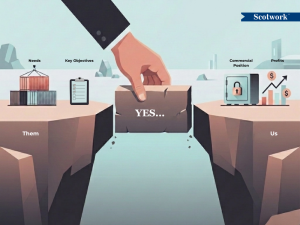
It seems both sides might actually want a version of the same thing:
- Employees want to benefit from increased productivity
- Employers want improvements that are real, measurable, and sustainable
That’s not conflict. That’s an amazing platform for a collaborative negotiation.
The Negotiation That Needs to Happen
The real conversation isn’t only:
“How much should we share?”
It’s:
What counts as productivity?
How do we measure it credibly?
When do gains trigger reward?
What moves in return? (flexibility, ways of working, capability, output)
Because ‘share the gains’ without structure becomes:
- Higher fixed costs
- Lower flexibility
And eventually… less investment.
A Scotwork View
If you treat this as a fairness debate and a zero sum game, you’ll get ‘digging in’ behind positions and a win/lose mentality.
But, if you treat it as a collaborative and interest based negotiation, you’ll get trades. And trades are where value is created.
A Final Thought
AI isn’t just a technology shift.
It’s created a shift in power and the opportunity to rethink the commercial models and pricing heuristics.
Handled well, this doesn’t need to be a fight. It could be one of the cleanest, most constructive negotiations we’ve seen in years.
If AI is going to change the way you do business this year, now’s the time to get clear on your negotiating strategy… not just what you’ll concede.
Get in touch to discuss!