Written by
In our most recent blog we explored how buyers need to take a considered approach when responding to a supplier’s price increase. The underlying idea was simple: don’t treat the price rise as a fact – treat it as the opening move.
This time, we will look at the other side of the table.
Because pushing a price rise is not just an administrative exercise. It is a negotiation.
And like all negotiations, it is shaped as much by perception, timing, and the execution as it is by cost.
Building a Business Case Isn’t Enough
The cost of doing business has gone up. Fuel, freight, commodities, raw input materials etc… all of these cost centres are forming the business cases for a price rise or surcharge pass through.
Spreadsheets are updated. Narratives are polished. Letters are carefully worded to explain why the increase is ‘necessary’.
It feels logical to assume that if the rationale is strong enough, the outcome will follow.
But many are starting to realise the difficulty is with the ‘What’…
- How much are we asking for?
- Is the objective to lift margin or recover costs?
- Do we build in a buffer?
- Which costs are we passing on? Do we pass on everything?
To help illustrate this, consider the ‘currency’ in which we plan to present the price rise because they come in many forms:
- Price per pallet
- Price per tonne
- One off surcharge as a single line item
- Built into the overall fee
This quickly becomes complex…. And all of this needs to happen before we even start crafting the message, let alone executing the delivery.
What Message Are You Planning to Send?
When you push a price increase, you are not just communicating a number.
You are signalling intent.
Understanding what we want to say and knowing that it might be received differently is an important consideration.
- A very direct and non-negotiable message might be effective at conveying our position. It might be received as an ultimatum, provoking unnecessary resistance.
- A detailed message with lots of explanation might be effective at justifying our position. It might also signal that justification is needed because we aren’t confident in our numbers.
How the price rise is perceived is just as important as the intent. We risk a lot if we lose control over the narrative….
The Execution is Where the Real Risks Are
Often the biggest challenge is not the decision to increase our price or pass through a surcharge, nor is it running the numbers and building a strong case.
The biggest risk is how consistent the message is executed across customers and over time.
Every team handles their conversations differently. They each have longstanding relationships with their customers and shared history.
- Some will hold firm.
- Some concede under pressure.
- Some present it as a negotiable ask, while others a fact
- Some avoid the conversation altogether.
It doesn’t take long before buyers start talking and the inconsistent pattern begins to emerge.
And the Biggest Barrier to an Effective Campaign…
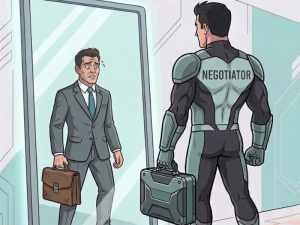
Confidence!
Organisations on both sides of the table are absorbing costs that they could easily be passing on because they are worried about the perception.
Pivoting away from absorbing the costs and lifting prices will also contribute to the concerns…
And all of this is before we start considering how the customers will respond, and the level of pushback to expect…
It’s easier said than done, so the question is. How will you know when you are ready?
Final Thoughts for Leaders
Teams that manage price rises well tend to approach them with the same discipline as any other negotiation. Our questions for leaders:
- Would you like to know how we determine what to ask for in the first place?
- Whether your team is actually executing that ask or quietly negotiating harder with you?
- And how to protect the ask when clients push back?
If these are live challenges in your business and you want our help testing your team’s readiness, get in touch.